Close announcement bar
Alert
Notice
We’re aware of an issue affecting the address finder on some forms. This is linked to a problem with an external service, which may mean you’re unable to complete your report or application at the moment. We’re monitoring the situation closely and will provide updates as soon as possible. Please try again later. We apologise for any inconvenience.

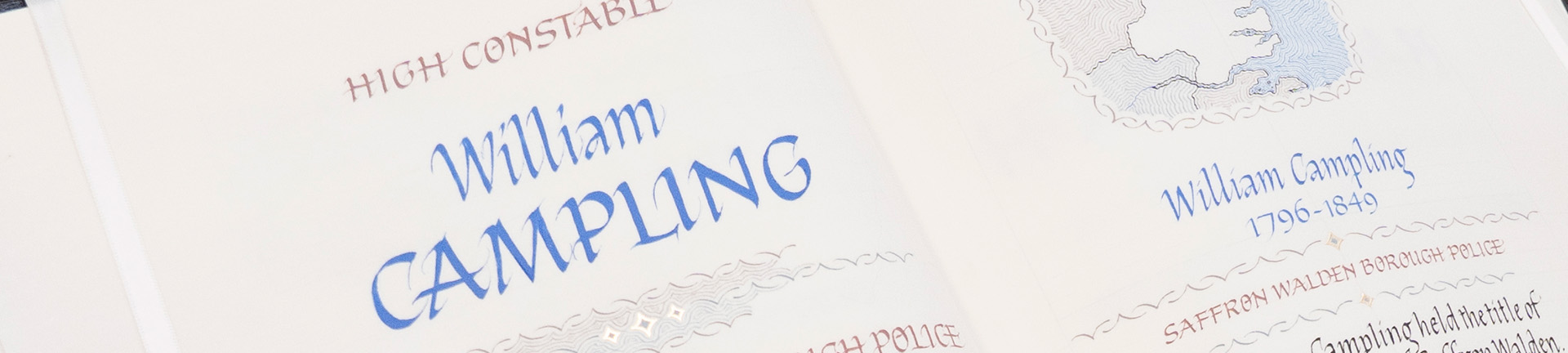
High Constable William Campling
- Served with Saffron Walden Borough Police.
- Died on 9 November 1849.
The Coroner's Inquest
On Friday 9 November 1849, a jury was called together by Mr W E Freeland, the Coroner for Saffron Walden. They were asked to look into the death of William Campling, who was the town’s Chief Constable at the time.
Mr Campling had been shot on Wednesday 31 October 1849. Around 40 to 60 pellets hit his left leg, and more than 60 hit his right leg. He died nine days later from shock caused by his injuries.
His death certificate does not mention his role in the police, but instead lists him as the Borough Surveyor. Back then, it was common for people to hold more than one official job.
Saffron Walden was one of four towns in Essex with a charter, which meant it could set up its own police force under a law passed in 1835. The force was very small and only lasted a short time, with just a few full-time and part-time officers.
Witnesses and evidence
Coroner Mr Freeland heard the following evidence:
Mary Brewer, daughter of the pork butcher, lived next door to the Campling family in Bridge Street. She said that around 10pm, stones were thrown at the door. She was upstairs with Miss Campling when they saw Mr. Campling returning home. They then heard a gunshot from across the road. When they went downstairs, they found Mr. Campling lying by the front door.
William Brand, a foreman working for Mr. Nockold, had walked with Mr. Campling to his house. He then walked up Windmill Hill Road towards North End. He heard a loud bang and saw smoke coming from the garden wall of Mr. Francis Gibson. He heard Mr. Campling say, “I’m shot. I'm shot.”
Bloomfield John Savill, a clerk to solicitor Mr. Collins, lived in Castle Street near the Waggon and Horses beer-house. At 4pm on the 31 October, he heard gunfire and saw Thomas Porter, the landlord, drawing a bucket of water. Benjamin Pettit was washing a gun in it. Savill had seen Pettit before climbing a wall near George Archer’s garden, which led into Francis Gibson’s property.
John Brewer, aged 15 and brother of Mary Brewer, also heard the shot and saw Mr. Campling lying by his door. He noticed a white dog with a rough head and short tail sniffing near Mr. Davis’s gate, close to Mr. Gibson’s garden. He had seen Pettit and Porter rat-catching before, and Porter had the same dog in Almshouse Lane, where Pettit lived. He didn’t know who owned the dog.
William Glover, a painter from Castle Street, said that at 8pm he saw Pettit walking past two men, who he believed were sawyers named Perry and Haslam. Borough Constable Wright was asked to bring these men to the inquest.
Surgeon Thomas Brown and his assistant Mr. Dickenson arrived shortly after the shooting. They found Mr. Campling in a hysterical state and carried him upstairs. The next morning, they removed eight gunshot pellets from his right leg and two from his left. Brown noticed signs of jaundice and later gangrene. Dr. Paget from Cambridge also attended, but both doctors agreed that the shooting caused Mr. Campling’s death. When asked by a juror, Brown said that amputating the leg would have caused death from shock.
George Brand, an apprentice to upholsterer Hannibal Dunn, saw Pettit in the Waggon and Horses at 9:30pm. Pettit was smoking but not drinking.
Alfred Stackwood, a wheelwright from Littlebury, said he had argued with Pettit on 19 May, but after that they were friendly. Pettit told him he struggled to control his temper and that Campling had made him angry. He had "made him pay a time or two and if he happened of him he would do for him."
Thomas Davis, under-gardener to Mr. W. G. Gibson, lived next door to Mr. Francis Gibson. He heard the shot and saw a sharp-nosed white dog run between his legs.
Constable James Wright searched Pettit’s house for a gun but didn’t find one. He took Pettit’s shoes and matched them to footprints found in Mr. Gibson’s garden. He also seized a full shot pouch.
Superintendent John Timewell Clarke, from the County Constabulary, examined the shot found by Wright. Three of the four types matched the pellets taken from Mr. Campling’s leg.
James Pettit (not related to Benjamin Pettit) gave evidence about what Glover said regarding Perry and Haslam. The jury was unhappy with his answers and behaviour. However, Edward Haslam gave evidence that the jury found fair. Charles Perry described a game played in the beer-house using a rifle barrel to blow darts at a target. Pettit was one of the players.
William Osborne, a labourer, said he had been with Perry and Haslam, not Pettit. He claimed Pettit was in the bar until 11pm, but the jury didn’t believe him and told him so. Robert Wren, another labourer, was in the bar from 8pm to 9:30pm but didn’t see Pettit.
The jury reassembled on Monday 12 November at 2:30pm to hear from Thomas Porter, landlord of the Waggon and Horses. Porter admitted owning two guns and said Pettit only used them when Porter was present. One gun was single-barrelled and about the size of a sixpenny piece.
Mary and Sarah Porter, Porter’s wife and daughter, also gave evidence. However, like Porter, they were unclear and unhelpful, so the coroner and jury stopped questioning them.
The dying man’s statement
Mayor Nathaniel Catlin said that Pettit was taken to the victim’s bedroom on the 8 November, the day after he was sent for trial. Campling, knowing he was dying, gave a statement. He said:
“On the 31st [October], at about 10:10pm, I left the Eight Bells Inn, which is about 40 yards from my house on Bridge Street. I walked and spoke briefly with Brand, then said ‘Goodnight’. After that, I was shot in the legs.”
Campling was carried upstairs. He told the people around him to find Pettit, saying:
“He had threatened me before. The last time was in Abbey Lane Passage, three or four months ago. I met him suddenly and he said, in anger, ‘You old —— you, I’ll do your business for you one of these days.’”
More witness statements
On the 14 November 1849, the jury met again.
Mr Paine, who worked for solicitor Thurgood, said he was with Mr Bedwell, an Excise Officer, in King Street late that night. They saw Pettit walking towards Almshouse Lane. He had his hands in his pockets, was whistling, and had a white dog with him.
Thurgood joined them, but no one spoke until a Constable arrived. They all went to see Mr Taylor, the Magistrate.
A few days later, Thurgood went with Pettit to Campling’s bedside. Pettit denied calling Campling names, but did not deny the attack.
James Dewberry, the Town Beadle, said Pettit was handed over to him. A town beadle was someone who helped keep order in the town, made announcements, and carried out small jobs for the local council or church. They also helped with basic law enforcement, like keeping public order and making sure local rules were followed.
As instructed, Dewberry went to the beer-house after midnight and said to Porter, “Tom, I want you.” Porter came without asking why and didn’t reply. When they reached Castle Street, Dewberry told him it’s a bad job "someone has shot the old gentleman.”
The jury gave a verdict of “wilful murder by some person or persons unknown.”
This was unusual because Benjamin Pettit had already been charged and sent for trial on 7 November for “shooting with intent.”
The Assize (Criminal trial)
Benjamin Pettit, aged 21, had been held in custody since November. He appeared before the judge at the Essex Lent Assize, held at Shire Hall in the second week of March 1850. An Assize was a type of court where judges travelled around the country to hear serious criminal cases like murder or robbery.
The prosecution, led by Russell Gurney QC, explained the case and made three key points:
- The shooting was not an accident. Stones were thrown at the door to make Campling come outside, where he was then shot.
- The attack wasn’t a robbery. It was likely caused by bad feelings towards Campling.
- The attacker had hidden near a small bridge over a stream (called a “slade” at the time) to carry out the shooting.
Many of the same witnesses from the earlier inquest gave evidence again.
William Payne, clerk to the Walden magistrates, spoke about the statement Campling gave before he died, which Pettit heard.
Constable James Byatt from Walden talked about a fight at a temporary theatre on the Common in July 1849. Pettit had clashed with the High Constable and was hurt.
Superintendent Clarke and Inspector Lunn from the Metropolitan Police gave evidence about footprints and the type of shot used.
Henry Shuttleworth, an ironmonger, looked at the shot found at Pettit’s home. He said they were sizes 3, 4, and 5 - exactly the same as the shot taken from Campling’s body.
Mr B. Thurgood, who arrested Pettit and took early statements, was not allowed to give evidence because the defence objected.
That was the prosecution’s case. Mr T Chambers led the defence and spoke to the jury.
At around 9:30pm, the jury returned a verdict of “not guilty.”
No one else was ever charged, and the case remains unsolved.
&w=1024&h=682&scale=both&mode=max)
Joining the Essex Constabulary
In 1857, when it became compulsory to police all areas, Harwich and Saffron Walden joined the Essex Constabulary because Saffron Walden had struggled to recruit officers.
The Eight Bells pub still stands, and about 40 yards away is Bridge End House, where the shooting likely happened.
The Waggon and Horses pub licence was moved to a different building, and Pettit’s home was in the Alms Houses on nearby Freshwell Lane, which were rebuilt a generation later.
&w=1024&h=683&scale=both&mode=max)
William Campling 1796-1849
Saffron Walden Borough Police
William Campling held the title of High Constable of Saffron Walden.
On 10th November 1849 he died from the effects of multiple gunshot wounds to his legs.
Though he named who he had though had wounded him on 31st October that year, no one was was ever convicted.